Sharing is caring!
Two announcements landed on the same day, at the same conference, pointing in what look like opposite directions.
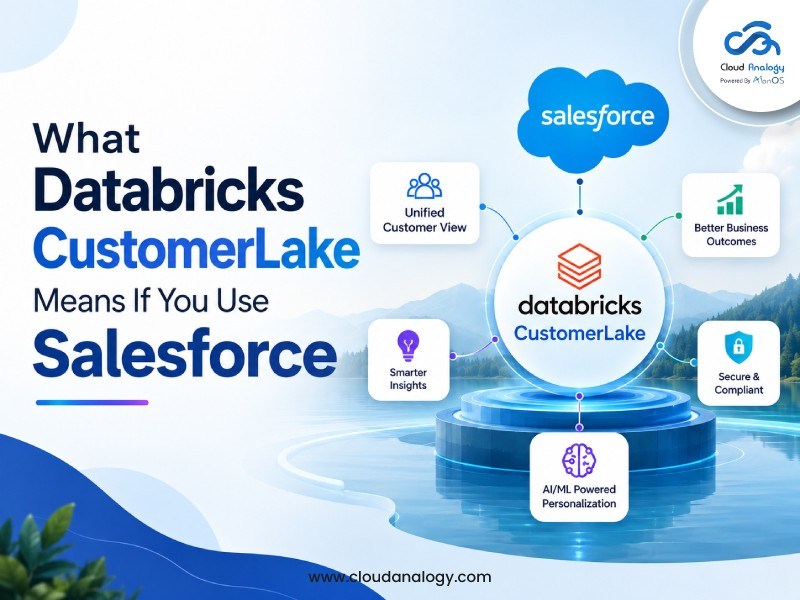
Databricks used Data + AI Summit on 16 June 2026 to launch CustomerLake, an agentic customer data platform built natively inside the lakehouse. It does customer unification, identity resolution, audience building and activation. That is CDP territory, and CDP territory is where Salesforce Data 360 lives.
The same day, from the same event, Salesforce announced an expanded partnership with Databricks covering governance, federated authentication and cross-platform search.
Most coverage picked one story or the other. If you run both platforms, the two need reading together, because the gap between them is where your architecture decisions now sit.
Table of Contents
- What Is Databricks CustomerLake?
- What Salesforce’s Databricks Partnership Means
- CustomerLake vs Salesforce Data 360
- What Databricks CustomerLake Brings to Salesforce Customers
- What Should Salesforce Customers Consider Before Adopting CustomerLake?
- What Does Databricks CustomerLake Mean for Your Salesforce Strategy?
- Frequently Asked Questions
What Is Databricks CustomerLake?
CustomerLake brings Customer 360, identity resolution, segmentation, campaign automation and activation into the lakehouse where the data and governance already sit. Profile Agents turn raw records into governed profiles using Agentic Identity Resolution, which Databricks describes as combining deterministic, probabilistic and agentic workflows.
Campaign Agents build audiences, recommend next-best actions and optimise against a business goal. Genie sits in front of both, so a marketer describes the audience they want in plain language, with no SQL and no ticket to the data team, and the segment they build inherits the security and lineage already applied to the underlying data rather than needing a separate permissions model bolted on.

The pitch is architectural rather than functional. Data stays put, Unity Catalog governance carries through to the agents acting on it, and there’s no separate CDP store in the middle collecting copies. Lakehouse Federation matters more here than it first appears, because customer data sitting in Snowflake, BigQuery or an operational database can feed profiles without being migrated first, which is the difference between a configuration exercise and a platform migration nobody budgeted for.
It’s in Private Preview, with HP, Circle K, AB InBev and Getnet by Santander named as current customers. The capability claims are Databricks’ own, and no independent benchmark exists yet.
What Salesforce’s Databricks Partnership Means
The two companies already had a Zero Copy partnership connecting Data 360, formerly Data Cloud, to Unity Catalog, alongside Bring Your Own Model, which lets teams train models in Databricks and deploy them into Salesforce AI.
June’s announcement extends that relationship in two directions.
Governance comes first, through federated authentication, planned identity mapping, governance interoperability and metadata-aware access controls. It is aimed at a problem every joint-estate team knows well: permissions get rebuilt separately in each platform and then quietly drift apart.
Discovery comes second, through a Federated Search designed to let Agentforce agents search Databricks and Databricks users search Salesforce.
So, on the same day Databricks shipped something that overlaps with Data 360, Salesforce committed to wiring the two platforms closer together, and Databricks named Salesforce its ISV Business App Partner of the Year at the same summit.
CustomerLake vs Salesforce Data 360: Where Do They Overlap?
The overlap is narrower than it looks.
Databricks CEO Ali Ghodsi has been direct that his company isn’t positioning against Salesforce, that the two remain partners, and that CustomerLake is about activation. He’s also said the marketing segment is going to change and that agents will drive significant disruption.
Both of those hold at once, because the two products touch in one place rather than everywhere.
Data 360 is where CustomerLake lands, not the CRM. Nothing in CustomerLake replaces the record of truth for accounts, opportunities, cases or consent, and nothing in it replaces where sellers and service teams do their work.

For a joint estate, the useful question was never which one wins. It’s which system holds which slice of customer context, and whether the connection between them is one deliberate pattern or an accumulation of point fixes made under deadline.
Salesforce keeps CRM attributes, consent state, service history and every workflow a seller or service agent touches. CustomerLake becomes a candidate for the signal that never reaches the CRM at all: product telemetry, web and app behaviour, loyalty transactions, commerce events and third-party enrichment.
That data already lands in the lakehouse, and until now acting on it meant either exporting to a separate CDP or commissioning bespoke pipelines.
Two decisions can’t be deferred: which system anchors identity for which identity space, and how consent state flows in both directions.
Get those wrong and you’ve built two competing customer views with a compliance problem in between.
What Databricks CustomerLake Brings to Salesforce Customers
Foundational Data 360 Zero Copy capabilities and the MuleSoft Agent Scanner for Databricks are generally available now.
Data 360 enhancements, Slack Genie App general availability, agentic search and MCP-driven integrations are rolling out through the second half of 2026 and beyond.
CustomerLake itself has no announced GA date, though Gartner’s first take on the launch expects general availability in the fourth quarter of 2026 or early 2027, and advises scheduling evaluations in the third quarter of 2026, a window that is nearly closed.
One more timing to be noted. Dreamforce runs from 15 to 17 September, and it is the obvious place for Salesforce to update the Data 360 roadmap and say more about the Databricks partnership. Anything announced there may move the dates above.
It will not move the structural question of which platform holds which slice of customer context. That is the part worth deciding now.
That split is what you plan against. Zero Copy is something to build on this quarter, while federated identity mapping is something to design toward rather than design around.
What Should Salesforce Customers Consider Before Adopting CustomerLake?
If you’re running Salesforce and Databricks together, the important question isn’t simply whether CustomerLake is another CDP option.
The bigger question is how Salesforce CRM, Data 360 and the Databricks lakehouse should divide responsibility for customer data. That means looking closely at:
- Customer identity: Which platform should anchor identity for each customer data domain?
- Consent management: How should consent and preference data move between Salesforce and Databricks?
- Data governance: Can existing governance policies remain consistent across both platforms?
- Data activation: Which customer signals should trigger action in Salesforce?
- Integration architecture: Are existing pipelines ready for the increased movement of data and activity between the two platforms?
- Customer context: Which platform should own which part of the overall customer view?
These decisions become especially important as organisations bring more Salesforce data, external data and operational data together.
The goal shouldn’t be to duplicate customer data across platforms simply because both systems can store or process it. The goal should be to give each platform a clear job and make the connection between them deliberate.
What Does Databricks CustomerLake Mean for Your Salesforce Strategy?
The two vendors most enterprises run together chose the same day to overlap in one place and integrate more deeply in another, which is less a contradiction than a fair description of how the market works now.
It also means the integration layer between CRM and lakehouse deserves more architectural attention than it usually gets. That points at something worth doing before any of these ships.
Look at the Salesforce-to-Databricks integration you already run. If it’s nightly batch jobs someone built years ago, agentic workloads arriving on both sides are the prompt to redesign it once, properly, rather than patch it for another two years. That work pays off whatever you decide about CustomerLake.
Frequently Asked Questions (FAQs)
What is Databricks CustomerLake?
Databricks CustomerLake is an agentic Customer Data Platform built natively within the Databricks Lakehouse for customer unification, identity resolution, segmentation and activation.
Is CustomerLake a replacement for Salesforce Data 360?
Not necessarily. The two platforms overlap in customer data capabilities, but Salesforce Data 360 is closely connected to Salesforce CRM and customer workflows, while CustomerLake is designed around the Databricks Lakehouse.
What is the difference between CustomerLake and Data 360?
The biggest difference is architectural positioning. CustomerLake is lakehouse-native, while Salesforce Data 360 is designed to bring customer data and intelligence into the Salesforce ecosystem.
Can Salesforce and Databricks work together?
Yes. Salesforce and Databricks have an expanded partnership covering Zero Copy data integration, governance, identity and federated search capabilities.
What is Zero Copy integration?
Zero Copy enables data to be accessed across Salesforce and Databricks without unnecessarily copying the underlying data between platforms.
Does CustomerLake work with Salesforce?
CustomerLake can be part of a broader Salesforce-Databricks architecture. The expanded partnership is specifically intended to make data, governance and agent workflows work more closely across the two platforms.
What does CustomerLake mean for Salesforce customers?
CustomerLake can be part of a broader Salesforce-Databricks architecture. The expanded partnership is specifically intended to make data, governance and agent workflows work more closely across the two platforms.
How does CustomerLake relate to Agentic AI?
CustomerLake uses agents for activities such as profile creation, identity resolution and campaign workflows, while Salesforce is using Agentforce to bring AI agents into business processes. Connecting trusted data across both platforms can provide agents with richer context.