Sharing is caring!
Artificial intelligence is transforming the way businesses operate, but successful AI implementation requires more than simply enabling new technology.
Salesforce Agentforce is helping organizations automate workflows, improve customer experiences, and empower employees through intelligent AI agents capable of reasoning and acting. However, the real challenge lies in adopting Agentforce effectively.
Without a structured implementation strategy, organizations often face issues related to poor data quality, unclear governance, security risks, and limited business value. The most successful companies treat Agentforce as a business transformation initiative rather than just another technology deployment.
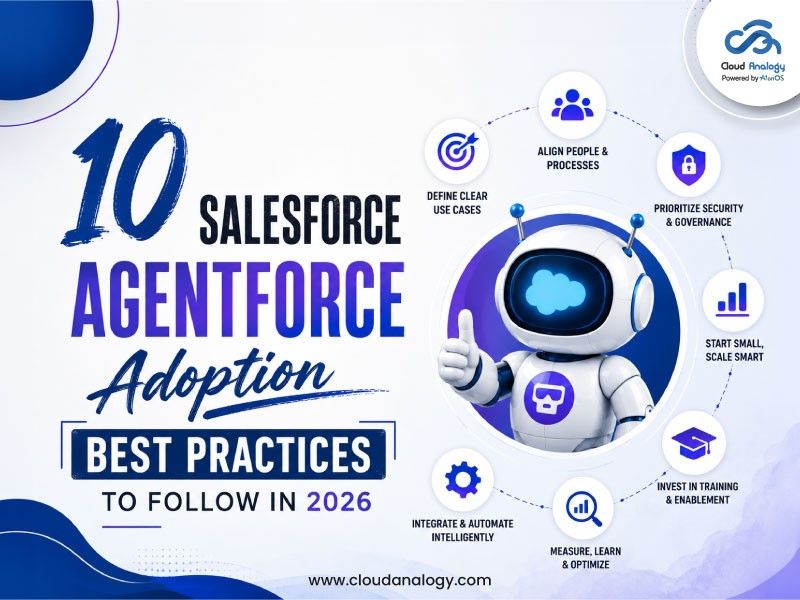
In this guide, we’ll explore the 10 Agentforce adoption best practices every business should follow to maximize ROI, improve operational efficiency, and confidently scale AI across the enterprise.
Why Agentforce Adoption Requires a Strategic Approach
Salesforce Agentforce empowers businesses to create AI agents capable of reasoning, taking action, and assisting employees across sales, service, marketing, and operations. While the technology is powerful, successful adoption depends less on AI itself and more on how organizations prepare their people, data, and business processes.
Organizations that focus only on deploying AI often encounter inconsistent results, security concerns, poor user adoption, and unreliable agent performance. Businesses that approach Agentforce with a structured implementation strategy achieve faster adoption, stronger governance, and measurable business outcomes.
Following proven best practices helps ensure your AI agents remain secure, reliable, scalable, and aligned with business objectives.
1. Start with High-Impact Use Cases and Scale Strategically
Rather than deploying Agentforce across your entire organization, begin with a single, high-value use case that delivers measurable business outcomes. Early successes provide valuable insights, reduce implementation risks, and build stakeholder confidence before expanding AI initiatives.
Best practices:
- Start with low-risk, high-impact processes like lead qualification or case routing.
- Measure KPIs such as response time, productivity, and autonomous case resolution.
- Validate business ROI before scaling to other departments.
- Use pilot projects to refine workflows and optimize performance.

2. Build AI on Actionable and Trusted Data
The effectiveness of Agentforce depends on the quality of the data it can access. Instead of collecting more data, focus on maintaining accurate, relevant, and actionable information that helps AI agents make better business decisions.
Best practices:
- Remove duplicate and outdated records.
- Standardize customer and business data.
- Improve record completeness and consistency.
- Organize data with meaningful context and relationships.
- Prioritize data usability over data volume.
3. Strengthen Security withRole-Based Access Controls
Every AI agent should have access only to the information required to perform its assigned tasks. Implementing the principle of least privilege minimizes security risks, protects sensitive business data, and ensures compliance across departments.
Best practices:
- Assign role-specific permissions to each agent.
- Restrict access to confidential or sensitive information.
- Prevent unauthorized record updates.
- Regularly review and update access controls.
- Strengthen governance with permission-based security policies.

4. Design Focused AI Agents with Clear Instructions
Clearly defined responsibilities help Agentforce deliver more accurate and predictable results. Instead of assigning broad objectives, configure AI agents to perform specific tasks with concise instructions and well-defined business topics.
Best practices:
- Create specialized agents for individual business functions.
- Define clear objectives and expected outcomes.
- Avoid combining unrelated tasks into one agent.
- Use simple, structured prompts and workflows.
- Regularly refine instructions based on performance insights.

5. Implement Intelligent Guardrails for Reliable AI Decisions
AI should operate within clearly defined business boundaries. Establishing guardrails ensures Agentforce follows organizational policies, compliance requirements, and approval processes while maintaining flexibility for intelligent decision-making.
Best practices:
- Configure approval workflows for sensitive actions.
- Enforce compliance and validation rules.
- Integrate Salesforce Flows and Apex with Agentforce.
- Apply Atlas Reasoning Engine for controlled AI reasoning.
- Continuously review governance policies as AI capabilities evolve.
6. Enhance Existing Salesforce Automation Instead of Rebuilding It
Agentforce works best when it complements your existing Salesforce automation rather than replacing it. Leveraging established Flows, Apex, and business logic reduces implementation complexity and accelerates deployment.
Best practices:
- Reuse existing Salesforce Flows wherever possible.
- Integrate Apex for advanced business logic.
- Trigger automation through intelligent AI actions.
- Preserve proven business processes while adding AI capabilities.
- Reduce technical debt by building on existing investments.
7. Select the Right Technology for Every Business Process
Not every workflow requires the same solution. Successful Agentforce implementations combine Salesforce technologies such as Flow, Apex, MuleSoft, Data Cloud, and External Services to deliver scalable and efficient automation.
Best practices:
- Use Salesforce Flow for CRM automation.
- Leverage Apex for complex processing.
- Connect legacy systems with MuleSoft APIs.
- Integrate third-party applications using External Services.
- Utilize Data Cloud for unified customer intelligence.
8. Keep Humans in the Loop for Critical Decisions
Agentforce is designed to augment employees not replace them. Human oversight remains essential for complex, high-value, or compliance-sensitive decisions where business judgment is required.
Best practices:
- Escalate complex customer issues to employees.
- Route financial approvals to authorized personnel.
- Enable seamless handoffs between AI and human teams.
- Review sensitive legal or compliance-related requests manually.
- Balance automation with human expertise to build trust.
9. Improve AI Accuracy with Clear Metadata and Documentation
AI agents rely on context to understand business processes. Well-documented metadata, data dictionaries, and process definitions help Agentforce interpret information accurately and deliver more reliable outcomes.
Best practices:
- Maintain comprehensive data dictionaries.
- Document business objects and field definitions.
- Standardize business terminology.
- Clearly define relationships between data objects.
- Keep documentation updated as processes evolve.
10. Continuously Monitor, Measure, and Optimize Performance
Agentforce adoption is an ongoing journey rather than a one-time implementation. Continuous monitoring helps organizations improve AI accuracy, increase user adoption, and identify opportunities for optimization as business needs evolve.
Best practices:
- Track AI success rates and business KPIs.
- Monitor response times and customer satisfaction.
- Measure user adoption across teams.
- Conduct regular testing and performance reviews.
- Refine workflows, prompts, and automations based on insights.
Conclusion
Implementing Salesforce Agentforce successfully requires far more than simply enabling AI capabilities. Organizations must establish a solid foundation built on quality data, strong governance, secure access controls, well-defined business processes, and ongoing performance monitoring. Starting with focused use cases, maintaining clear documentation, integrating existing Salesforce automation, and keeping humans involved in critical decisions significantly improve adoption success.
As businesses continue embracing autonomous AI, those that prioritize strategy over speed will gain the greatest competitive advantage. By following these Agentforce adoption best practices, organizations can confidently scale AI across departments, improve operational efficiency, deliver better customer experiences, and achieve measurable business outcomes. A thoughtful, structured approach ensures Agentforce becomes a trusted business asset that drives long-term innovation and sustainable growth.
Frequently Asked Questions (FAQs)
What is Salesforce Agentforce?
Salesforce Agentforce is an AI-powered platform that enables businesses to build autonomous agents capable of performing tasks, assisting employees, and improving customer experiences.
Why is Agentforce adoption important?
Successful Agentforce adoption helps organizations automate repetitive work, improve productivity, enhance customer service, and increase operational efficiency.
What is the biggest challenge in Agentforce implementation?
Poor data quality, unclear business objectives, weak governance, and lack of continuous monitoring are among the most common challenges.
Why should businesses start with small Agentforce projects?
Starting with a focused use case allows organizations to validate ROI, reduce implementation risks, and build confidence before expanding AI across the enterprise.
How important is data quality for Agentforce?
High-quality, actionable data enables AI agents to make accurate decisions, automate workflows effectively, and deliver reliable business outcomes.
Should AI replace employees?
No. Agentforce is designed to augment human teams by automating repetitive tasks while allowing employees to focus on higher-value work.
How can businesses measure Agentforce success?
Track KPIs such as autonomous case resolution, customer satisfaction, productivity improvements, response times, AI accuracy, and overall business ROI.
How often should Agentforce be monitored?
Businesses should continuously monitor agent performance, data quality, user feedback, and business metrics to ensure consistent improvement and long-term success.
What do Salesforce Agentforce consulting services include?
Salesforce Agentforce consulting services help businesses identify practical AI use cases and determine how Agentforce can fit into their existing Salesforce environment. A consultant can help with agent design, data readiness, automation, integrations, testing, and ongoing optimization. The goal is to make Agentforce useful for real business processes rather than simply adding AI to the platform.
Why should businesses work with an Agentforce implementation partner?
An Agentforce implementation partner can help businesses move from planning to a working Agentforce solution. This may include configuring agents, connecting Salesforce data and workflows, testing responses, setting up governance, and supporting the solution after launch. An experienced partner can also help businesses start with the right use cases and expand Agentforce as they gain confidence.