Understanding Salesforce Model Context Protocol: Everything You Need to Know
Understanding Salesforce Model Context Protocol: Everything You Need to Know
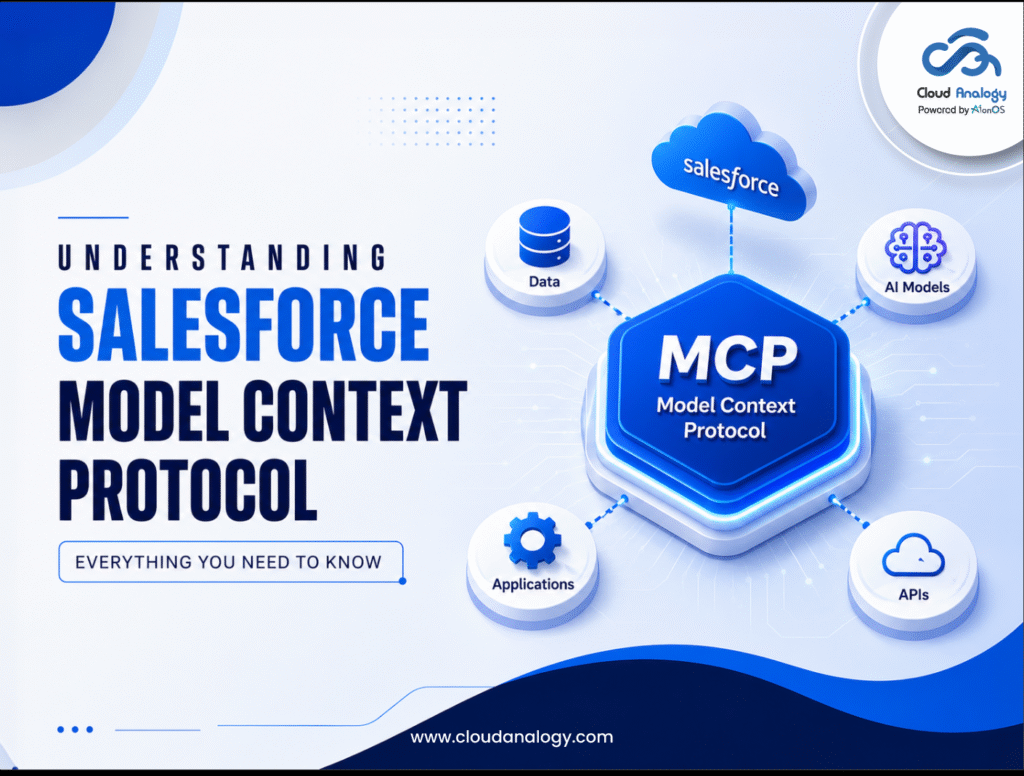
Artificial Intelligence (AI) is revolutionizing how businesses interact with customers, process information, and automate workflows. However, one big challenge that interferes is: AI can speak intelligently, but it often lacks an understanding of your actual business environment. Traditional AI models can generate answers based on training data, but they do not naturally understand your CRM records, customer history, sales pipelines, workflows, approval processes, or operational logic.
Imagine asking an AI assistant: “Which leads are most likely to convert this month?”
Without direct access to your CRM data and business rules, the AI may provide assumptions rather than meaningful answers. Today, we expect AI to create opportunities, generate insights, automate workflows, and assist with business decisions rather than just answer generic questions.
This is where the Model Context Protocol (MCP) comes into the picture.
MCP acts as a bridge between AI systems and enterprise applications like Salesforce. Rather than creating multiple hardcoded integrations for every AI use case, MCP establishes a universal framework that enables AI to securely access systems, understand context, and take actions.
As businesses continue investing in AI-powered CRM experiences, organizations are increasingly relying on Salesforce Consulting Services, Salesforce Agentforce Consulting Services, and experienced Salesforce consulting Partner teams to implement scalable and future-ready AI solutions.
In this blog, we will explore everything you need to know about Salesforce Model Context Protocol, including its architecture, working mechanism, advantages, challenges, and future impact on enterprise AI.
- Understanding Model Context Protocol (MCP)
- Why Traditional AI Falls Short in Enterprise Systems
- How Salesforce Model Context Protocol Works
- Core Components and Architecture of MCP
- Key Benefits of Salesforce MCP
- Common Challenges of MCP Implementation
- Future of MCP and the Salesforce AI Ecosystem
- Conclusion
Understanding Model Context Protocol (MCP)
Model Context Protocol (MCP) is an open-standard communication framework designed to allow AI systems to securely communicate with external tools, business applications, databases, and APIs.
MCP is frequently referred to as the: USB-C for AI”
The reason behind this comparison is simple. Like how USB-C enables devices to connect through a common standard, MCP creates a universal language for AI systems to interact with external environments.
Instead of developing separate APIs and custom integrations for every application, MCP allows AI systems to dynamically discover:
- Available actions
- Business tools
- System capabilities
- Data structures
- Contextual information
This significantly reduces development complexity and creates a more intelligent AI ecosystem.
Why Traditional AI Struggles in Enterprise Systems
Despite advances in AI technologies, several limitations continue to exist:
Lack of real-time information: AI may rely on training data instead of live business data.
Disconnected systems: Business data often exists across:
- CRM platforms
- ERP applications
- Marketing tools
- Service platforms
- Communication systems
No business understanding: AI may know the meaning of “lead” but may not understand:
- Lead qualification criteria
- Opportunity stages
- Internal workflows
- Company-specific terminology
This gap creates inaccurate recommendations and limits automation capabilities

MCP follows a structured process that allows AI systems to gather business context before producing outputs.
Step 1: User Sends a Request
Suppose a sales manager asks: “Show customers with high renewal probability for next quarter.”
The AI understands that additional business information is required before answering.
Step 2: MCP Identifies Relevant Systems: The protocol determines:
- Which systems contain required information
- Available permissions
- Accessible tools
- Required business actions
Step 3: Salesforce Supplies Business Context: Salesforce provides relevant information including:
- Customer account details
- Opportunity records
- Customer interactions
- Purchase history
- Support cases
- Activity history
Step 4: AI Processes Information: The AI analyzes available information and identifies patterns.
Examples include:
- Buying behavior
- Renewal likelihood
- Customer engagement levels
- Pipeline movement
Step 5: AI Generates Intelligent Recommendations: The AI can then:
- Recommend next steps
- Create tasks automatically
- Predict churn
- Generate reports
- Prioritize opportunities
Real Example
Without MCP: “How many demos did Dan schedule?”
AI simply counts all assigned records.
With MCP: AI understands business logic and excludes:
- Auto-assigned leads
- No-touch records
- Invalid attribution data
This creates significantly more accurate outcomes.

MCP operates using a client-server architecture consisting of several components.
Host – The host represents the primary AI application.
Examples include:
- Salesforce Agentforce
- ChatGPT
- AI Copilot systems
Responsibilities:
- Receives user requests
- Initiates workflows
- Coordinates interactions
Client: The client acts as a communication layer between the AI and external systems.
Functions include:
- Request translation
- Connection management
- Data transfer
Server: The server securely exposes system capabilities.
Examples:
- Salesforce environments
- Databases
- External applications
- Third-party systems
Tools: Tools represent executable functions.
Examples:
- Create lead
- Update opportunity
- Trigger workflow
- Execute SOQL query
Resources: Resources provide contextual information.
Examples:
- Customer profiles
- CRM records
- Metadata
- Knowledge articles
Prompts: Prompts provide reusable templates and instructions.
Examples:
- Sales playbooks
- Customer communication templates
- Workflow instructions
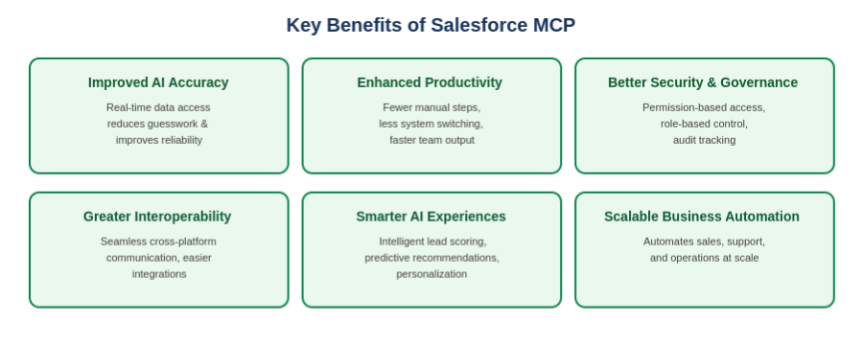
- Improved AI Accuracy
MCP enables AI to access real-time business data, reducing guesswork and improving response quality with more reliable insights and recommendations. - Enhanced Productivity
By minimizing manual processes and reducing the need to switch between systems, MCP helps teams work faster and improve overall operational efficiency. - Better Security & Governance
MCP follows permission-based access controls, ensuring secure data usage through user authorization, role-based access, and audit tracking. - Greater Interoperability
MCP creates seamless communication across platforms, enabling easier integrations and reducing dependency on isolated business systems. - Smarter AI Experiences
With better business context, AI can deliver intelligent lead scoring, predictive recommendations, personalized interactions, and automated workflows. - Scalable Business Automation
MCP supports intelligent automation across sales, support, and operational processes, helping businesses scale efficiently while reducing repetitive work.

- MetadataDoesn’tAlways Mean Understanding
AI may access fields and objects but still fail to understand actual business logic, leading to inaccurate recommendations and decisions. - Managing Enterprise Complexity
Large Salesforce environments often include thousands of workflows, automation rules, and custom objects, making implementation and management more challenging. - Limited Agent Memory
Some AI implementations process requests independently, creating difficulties in handling multi-step workflows andmaintaining historical context. - Security & Compliance Risks
Organizations mustestablish strong permission controls, data privacy measures, governance policies, and compliance standards to ensure secure AI interactions. - Business Context Gaps
Without understanding company-specific processes and terminology, AI outputs can appear technically correct but lack practical business relevance. - Scalability and Governance Challenges
As AI usage expands across systems,maintaining consistency, control, and governance across multiple integrations can become increasingly complex.
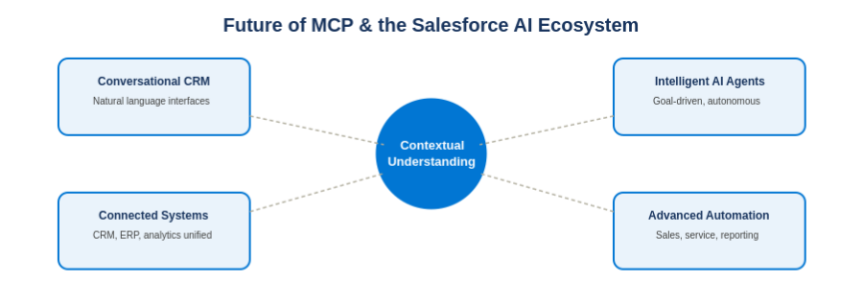
The future of AI will depend heavily on contextual understanding rather than standalone intelligence.
As AI adoption continues growing, organizations can expect:
More Conversational CRM Systems: Users will interact with business applications naturally using language instead of navigating complex interfaces.
Intelligent AI Agents: Future AI assistants will:
- Understand organizational goals
- Execute business processes
- Learn workflows
- Support decision-making
Connected Business Systems: CRM systems, ERP platforms, communication tools, and analytics platforms will operate through unified standards.
Advanced Automation: Businesses will increasingly automate:
- Sales operations
- Customer service
- Reporting
- Lead management
- Workflow orchestration
Conclusion
Artificial intelligence becomes truly valuable only when it understands the business behind every interaction. The Model Context Protocol (MCP) represents an important step toward creating intelligent, connected, and scalable business ecosystems. As organizations continue embracing AI at scale, MCP will play a critical role in helping businesses build smarter workflows and deliver more personalized experiences.
Organizations leveraging Salesforce Consulting Services, Salesforce Agentforce Consulting Services, and an experienced Salesforce consulting Partner will be better positioned to capitalize on this evolving AI landscape.
Ready to build smarter AI experiences with Salesforce? Transform your Salesforce ecosystem with Cloud Analogy, a reliable Salesforce summit consulting partner. Whether you want to implement AI-powered workflows, optimize Agentforce capabilities, or modernize CRM operations, Cloud Analogy can help.
Contact Cloud Analogy today and discover how our Salesforce development experts can create intelligent, scalable, and future-ready business solutions for your organization.
Frequently Asked Questions
What is Salesforce Model Context Protocol?
Why is MCP important for Salesforce?
Does Salesforce currently support MCP?
What are the benefits of MCP?
How can a Salesforce consulting Partner help with MCP implementation?