Sharing is caring!
Commerce post-purchase experience has become a key factor in building customer trust and long-term brand loyalty. Today’s customers expect seamless order tracking, faster deliveries, hassle-free returns, and real-time communication throughout their buying journey.
Businesses that fail to deliver a smooth post-purchase experience often face customer dissatisfaction, operational delays, and lower retention rates.
This is where Salesforce Order Management System (OMS) plays a transformative role. Salesforce OMS helps businesses automate and streamline order processing, inventory management, fulfilment, shipping, returns, & payment coordination across multiple channels. Integrated with Commerce Cloud, Sales Cloud, and Service Cloud, Salesforce OMS delivers a connected customer experience.
Partnering with a trusted Salesforce consulting partner ensures successful implementation and optimized Salesforce consulting services for scalable growth.
Table Of Contents
- What is Salesforce Order Management System (OMS)?
- Why Businesses Need Salesforce OMS
- Key Features of Salesforce OMS
- Benefits of Salesforce Order Management System
- Understanding the Salesforce Order Lifecycle
- How to Choose the Right OMS for Your Business
- Use Cases of Salesforce OMS
- Journey of an Order in Salesforce OMS
- Why Choose Salesforce Consulting Services for OMS Implementation
What is Salesforce Order Management System (OMS)?
Salesforce Order Management System (OMS) is a comprehensive solution designed to manage the complete post-purchase lifecycle of an order. It centralizes order processing, inventory visibility, fulfillment operations, payment handling, shipping coordination, returns, and customer support into one unified platform.
Salesforce OMS integrates natively with Salesforce Commerce Cloud, Sales Cloud, and Service Cloud, helping businesses deliver connected customer experiences while improving operational efficiency. It acts as a standalone OMS solution while seamlessly integrating with ERP systems, payment gateways, shipping providers, and third-party applications.
The platform enables organizations to manage orders from multiple channels including eCommerce websites, marketplaces, mobile applications, and physical stores.
Why Businesses Need Salesforce OMS
Modern commerce businesses deal with growing customer expectations and increasing operational complexity. Manual order management processes often lead to shipping delays, inventory mismatches, poor customer communication, and increased operational costs.
Salesforce OMS helps businesses overcome these challenges by:
- Automating manual order workflows
- Managing orders across multiple channels
- Improving inventory visibility
- Streamlining fulfillment and returns
- Providing real-time order tracking
- Enhancing customer service experiences
- Delivering actionable analytics and insights
Businesses working with a trusted Salesforce consulting partner can optimize these processes and implement a scalable OMS strategy tailored to their industry needs.
Key Features of Salesforce OMS
- Intelligent order orchestration and routing to optimal fulfillment centers
- Native integration with Commerce, Sales, and Service Clouds
- Flexible fulfillment models: Ship from Store, BOPIS, drop shipping, and warehouse
- Automated returns and cancellations with real-time inventory updates
- Customizable Flow Builder for fraud checks, split shipments, and backorders
- Built-in fraud detection via third-party integrations
- Advanced reporting dashboards for actionable insights
- Multi-currency, multi-language, multi-region scalability
Top Benefits of Salesforce OMS
- Unified Order View: Aggregates orders from web, mobile, marketplaces, and stores on a single platform.
- Smarter Automation: Reduces manual effort and errors across order capture, billing, and fulfillment.
- Real-Time Visibility: Keeps internal teams and customers informed at every stage of the order lifecycle.
- Enhanced Customer Experience: Self-service returns, proactive notifications, BOPIS, and curbside pickup options.
- Global Scalability: Supports international expansion with localized tax, currency, and shipping rules.
- Data-Driven Decisions: Native analytics reveal order trends, return patterns, and fulfillment performance.
Understanding the Salesforce Order Lifecycle
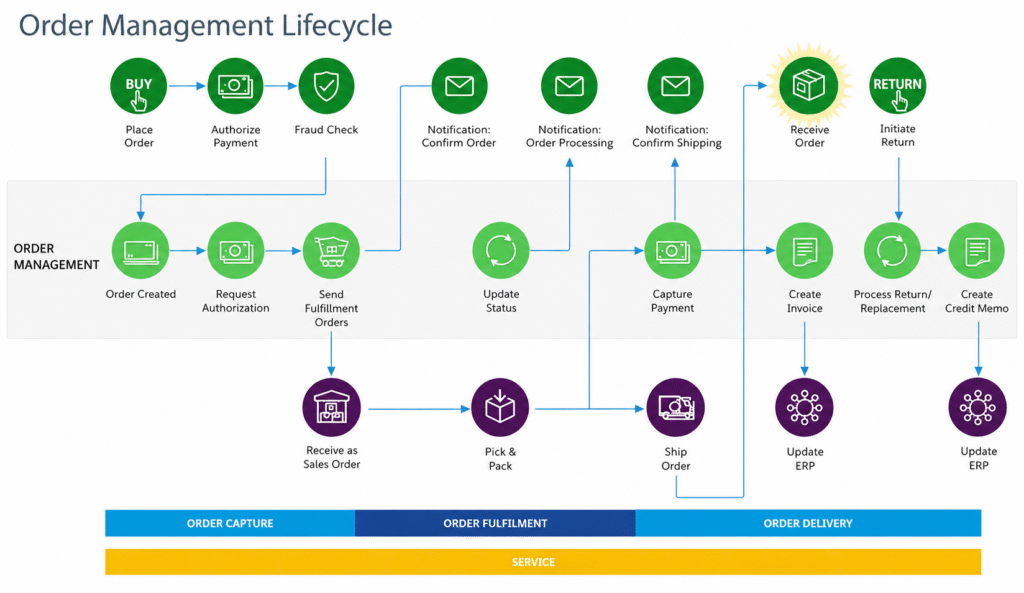
A typical Salesforce OMS workflow includes:
- Customer places an order through a storefront or marketplace
- Order data is integrated into Salesforce
- Customer profiles are matched with CRM records
- OMS creates order summaries and fulfillment records
- Fraud checks are initiated through third-party integrations
- Orders are routed to fulfillment centers
- Inventory quantities are updated
- Fulfillment providers process shipments
- Shipping notices are generated
- Invoices are created and synced with ERP systems
- Customers receive tracking updates and delivery notifications
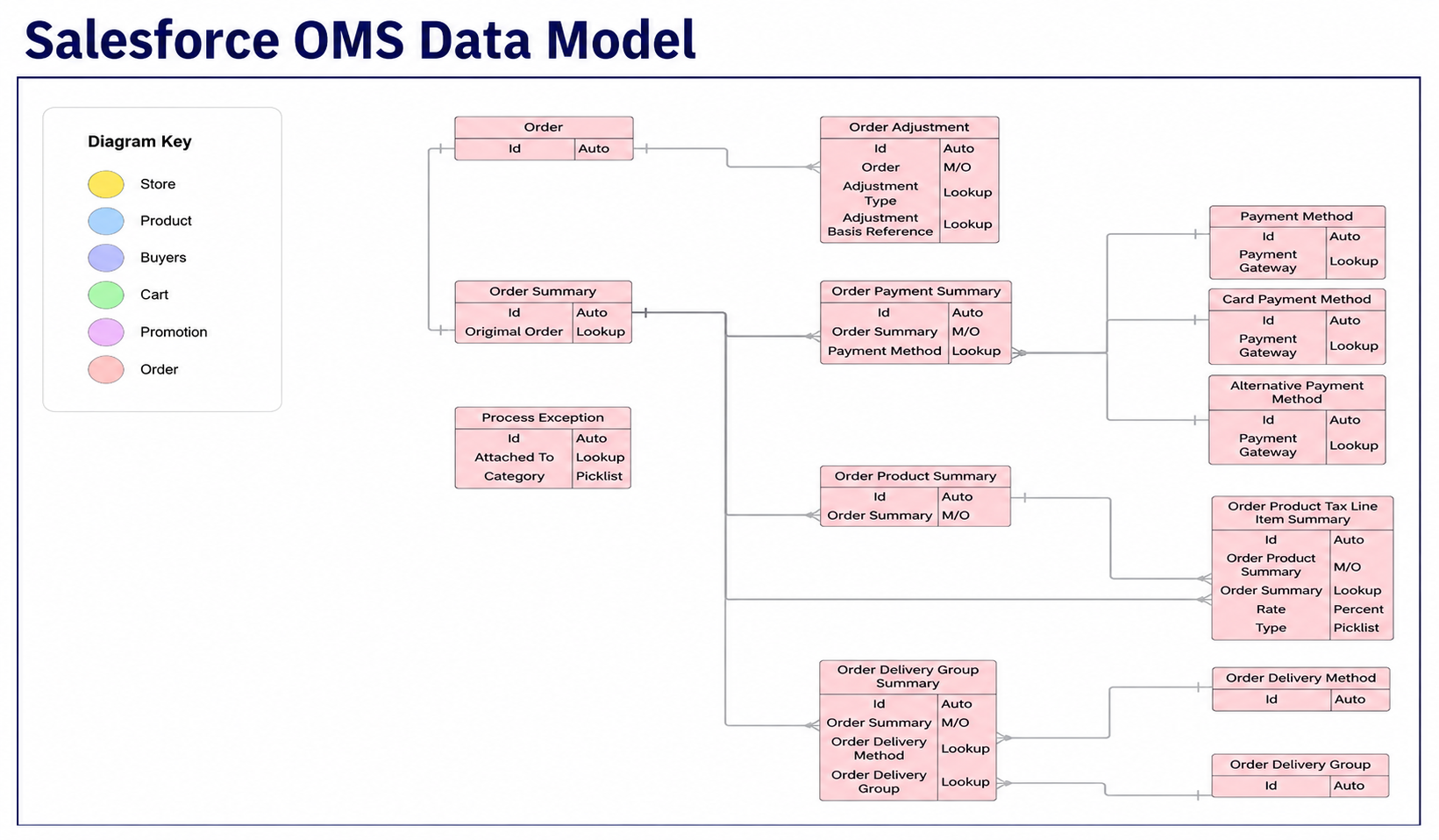
Order vs Order Summary
Order | Order Summary |
An Order represents the original customer intent, including order creation and modifications. Once activated, the order remains immutable. | An Order Summary reflects the current state of the order, including fulfillment updates, returns, cancellations, and shipment status. It continuously updates based on changes made throughout the order lifecycle. |
How to Choose the Right OMS for Your Business
Selecting the right Order Management System depends on your business requirements and operational challenges. A knowledgeable Salesforce consulting partner can assess your business processes and recommend the best OMS strategy for long-term growth.
Key factors to evaluate include:
- Current system limitations and pain points
- Multi-channel order management capabilities
- Inventory visibility requirements
- Fulfillment flexibility
- Scalability and customization
- Integration with CRM, ERP, and commerce systems
- Reporting and analytics capabilities
- Customer self-service functionality
Use Cases of Salesforce OMS
- Omnichannel Retail Operations: Manage orders across websites, mobile apps, marketplaces, and physical stores from one platform.
- Buy Online Pick Up In-Store (BOPIS): Allow customers to place orders online and collect them from nearby store locations.
- Curbside Pickup: Enable contactless order fulfillment with automated notifications and pickup coordination.
- B2B Order Management: Handle complex wholesale orders, bulk shipments, and invoice-based payments efficiently.
- Returns and Refund Automation: Simplify return management while automatically updating inventory and financial systems.
- Global Commerce Expansion: Support multiple currencies, languages, regional tax structures, and shipping rules for international operations.
Why Choose Salesforce Consulting Services for OMS Implementation
Implementing Salesforce OMS requires careful planning, system integration, customization, and workflow automation. Businesses often rely on experienced Salesforce consulting services to ensure successful deployment and optimization.
A reliable Salesforce consulting partner can help with:
- OMS strategy and implementation
- Commerce Cloud integration
- ERP and payment gateway integration
- Workflow automation
- Inventory and fulfillment optimization
- Reporting dashboard setup
- Custom UI development
- Post-deployment support and maintenance
By leveraging expert Salesforce consulting services from Cloud Analogy, organizations can accelerate digital transformation while improving operational efficiency and customer satisfaction.
The Bottom Line
Salesforce Order Management System is more than just an order processing solution. It is a powerful platform that helps businesses deliver seamless post-purchase experiences, streamline operations, and scale efficiently in today’s competitive commerce landscape.
From intelligent order routing and real-time inventory visibility to automation and omnichannel fulfilment, Salesforce OMS empowers businesses to improve customer satisfaction while reducing operational complexity.
Whether you are a fast-growing retailer or an enterprise organization, implementing Salesforce OMS can help future-proof your operations and enhance customer loyalty. Partnering with an experienced Salesforce consulting partner ensures your OMS implementation aligns with your business goals and delivers maximum value.
Frequently Asked Questions (FAQs)
What is Salesforce Order Management System?
Salesforce OMS is a platform that helps businesses manage order processing, fulfilment, returns, inventory, and customer service from a centralized system. Many businesses work with a Salesforce consulting partner for successful implementation.
Why is Salesforce OMS important for businesses?
Salesforce OMS improves operational efficiency, automates workflows, and enhances customer experiences with real-time order visibility and faster fulfilment.
Can Salesforce OMS integrate with other Salesforce products?
Yes, Salesforce OMS integrates seamlessly with Commerce Cloud, Service Cloud, and Sales Cloud, enabling unified business operations.
What industries can use Salesforce OMS?
Retail, eCommerce, manufacturing, wholesale, and distribution businesses commonly use Salesforce OMS to manage complex order operations.
How do Salesforce consulting services help with OMS implementation?
Professional Salesforce consulting services help businesses customize workflows, integrate systems, automate processes, and optimize OMS performance based on specific operational needs.
Does Salesforce OMS support omnichannel commerce?
Yes, Salesforce OMS supports online stores, marketplaces, mobile applications, and physical retail stores from a single platform.
Can Salesforce OMS manage returns and refunds?
Yes, Salesforce OMS automates returns, refunds, cancellations, and inventory updates for a seamless post-purchase experience.
Is Salesforce OMS scalable for global businesses?
Absolutely. Salesforce OMS supports multiple currencies, languages, tax structures, and international shipping processes, making it ideal for global operations.

Sachin Arora
Scrum Master and Principal Solutions Architect
Sachin, a renowned Scrum Master and Principal Solutions Architect at Cloud Analogy, has rich experience when it comes to working on process improvement in a fast-paced environment maintaining high level of quality in all deliverables. Sachin's expertise lies in varied hardware and software environments including Cloud technologies such as Salesforce, AWS, Cloud Foundry & Google App Engine and Mobile.Hire the best Salesforce Development Company. Choose certified Salesforce Developers from Cloud Analogy now.