Sharing is caring!
Customer expectations are shifting fast. CRM systems can no longer depend on manual inputs or delayed decisions. Businesses need tools that turn data into immediate action. This is where AI agents change the game.
At Cloud Analogy, we help companies move from reactive CRM workflows to proactive automation using intelligent systems. Platforms like MCUtility strengthen this shift by enabling faster, smarter CRM operations supported by AI-driven workflows.
What Are AI Agents in CRM?
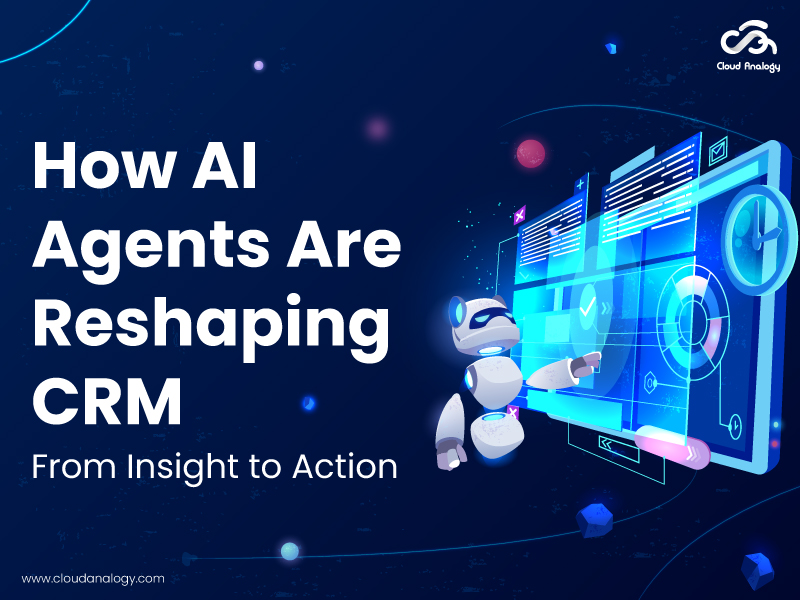
AI agents are autonomous tools that analyze data, make decisions, and perform tasks inside a CRM without human intervention. They move CRM systems from static dashboards to real-time action engines. In Salesforce and other CRM ecosystems, AI agents help automate communication, predict customer behavior, and trigger workflows instantly. This is a major step toward intelligent operations powered by Salesforce automation and modern data tools.
Why AI Agents Matter in CRM
AI agents are important because they convert insights into automated outcomes. CRM teams no longer wait for manual reviews or repetitive tasks.
Key reasons they matter:
- Instant decisions: AI agents analyze behavior, intent, and history to recommend or execute the next best action.
- Improved efficiency: They reduce manual work in data entry, ticket routing, forecasting, and lead qualification.
- Always-on workflows: AI agents run 24/7, ensuring no lead, case, or opportunity goes unnoticed.
- Enhanced personalization: They adapt customer journeys based on patterns and preferences, improving loyalty.
- Better ROI: Businesses save time, reduce errors, and speed up processes with intelligent automation.
Cloud Analogy integrates AI workflows, predictive models, and automated actions within Salesforce to make these capabilities stronger for enterprises.
How to Use AI Agents to Automate CRM Workflows
Follow these steps to apply AI agents effectively inside CRM platforms:
1. Identify the use case
Pick one area that needs automation. It can be lead qualification, customer support, or follow-ups.
2. Pull clean data
AI agents need accurate CRM data. Clean duplicates, fix incomplete records, and standardize fields.
3. Set up triggers
Create rules like “When a lead score crosses X” or “When a case is pending for 2 hours.” These conditions help the AI agent act.
4. Define tasks for the agent
Tell the agent what to do, update a record, send an email, classify a ticket, or assign it to a team.
5. Add intelligence
Use predictive scoring, sentiment analysis, and behavior patterns to refine actions. This is where CRM AI becomes powerful.
6. Integrate with tools
Connect agents with platforms like MCUtility, email apps, chat systems, and support tools to widen automation.
7. Test and observe
Run simulations to check accuracy. Adjust triggers and outputs until performance improves.
8. Deploy and monitor
Once ready, activate the agent. Track results weekly to ensure workflows remain sharp.
Cloud Analogy supports end-to-end setup,strategy, development, integration, and optimization,ensuring your AI-powered CRM workflows deliver consistent value.
Key Benefits of Using AI Agents in CRM
AI agents transform CRM operations. Here are the strongest benefits:
- Faster response times: Customers receive instant replies and resolutions.
- Smarter automation: AI agents understand context and choose actions based on historical data.
- Reduced workload: Teams focus on strategy while agents handle repetitive tasks.
- Higher conversion rates: AI-driven recommendations and follow-ups improve lead engagement.
- Stronger platform efficiency: With tools like MCUtility, CRM becomes more organized, responsive, and adaptable.
MCUtility acts as a bridge that enhances CRM performance by syncing activities, optimizing workflows, and enabling automated actions that support AI agents.
Common Mistakes to Avoid with AI Agents
Avoid these challenges when implementing CRM AI agents:
- Not training the agent: Always feed accurate, updated data. Poor data reduces AI accuracy.
- Over-automation: Start small. Automate only essential tasks before scaling.
- Ignoring human validation: Add checkpoints for high-impact actions like discounts or escalations.
- No monitoring: AI agents improve over time. Review performance regularly.
Conclusion
AI agents are shifting CRM from passive data storage to active decision-making systems. They help teams move faster, automate key tasks, and offer customers better experiences. With Cloud Analogy’s expertise and tools like MCUtility, businesses can adopt AI-powered CRM workflows with confidence. Start optimizing your CRM today with AI-driven automation and smarter insights.
Frequently Asked Questions (FAQs)
AI agents automate tasks, improve decision-making, and help teams act on insights faster. They reduce manual work and allow companies to manage customers more efficiently.
Yes. AI agents integrate well with Salesforce using automation, predictive scoring, and workflow tools. Cloud Analogy helps companies deploy these integrations smoothly.
Not always. With a strategy, clean data, and the right tools, setup becomes simple. Solutions like MCUtility and Cloud Analogy’s Salesforce services make the process easier.
They automate lead qualification, routing, follow-ups, ticket categorization, email responses, and pipeline updates. They also analyze user behavior for personalized experiences.
A Salesforce Consulting Partner can implement this integration to enhance client workflows, streamline meeting management, and unify CRM-driven engagement strategies, even across different CRM landscapes.