Sharing is caring!
“Revenue doesn’t fail because of lack of effort—it fails because of lack of visibility.“
One question that dominates every growth conversation is: “Can we trust our numbers?” 70% of businesses report lost revenue due to poor communication between departments.
Today, Sales, marketing, finance, & customer success team each generate massive volumes of data—but without alignment, that data becomes noise rather than insight.
Revenue Operations (RevOps) has emerged as the strategic backbone that transforms how organizations approach revenue generation, and Salesforce is the CRM platform where this transformation truly comes to life.
Yet many organizations fail to unlock its full power because their RevOps reporting doesn’t scale.
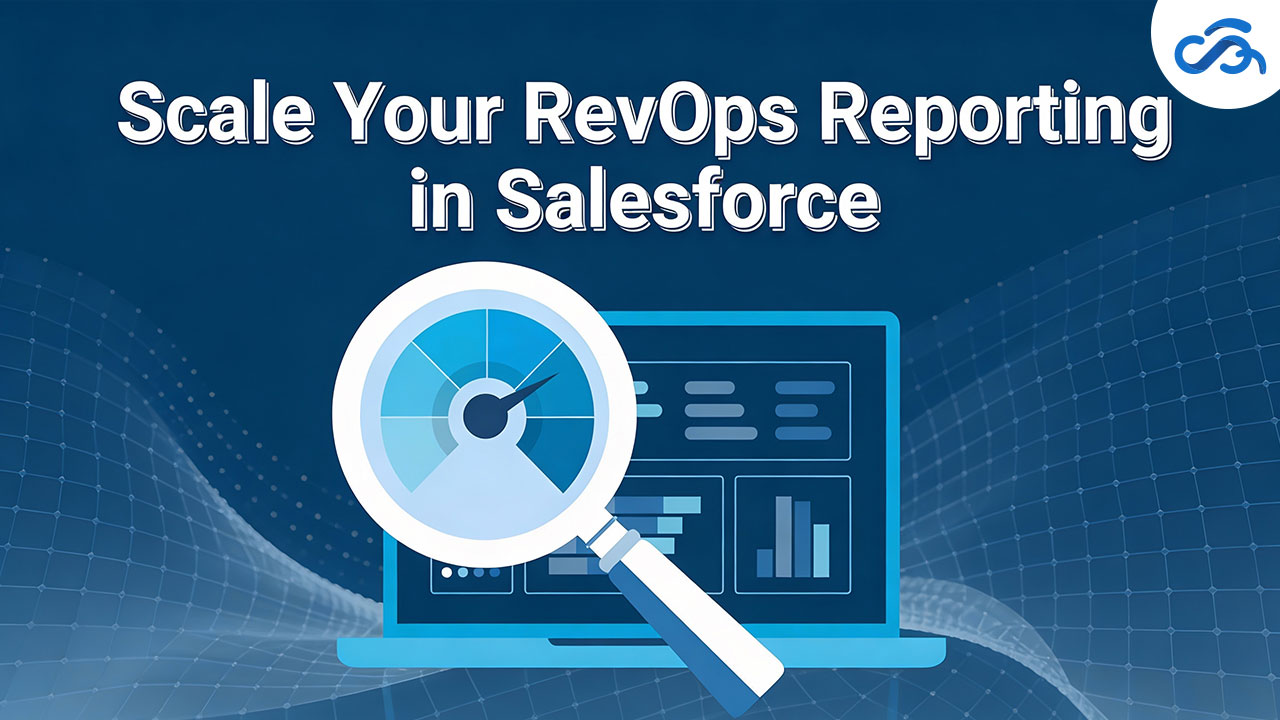
This blog explores why Salesforce reporting is a must-have for RevOps teams, the benefits it delivers, and five actionable ways to optimize and scale your reporting for maximum impact.
What is RevOps Reporting & Why Does It Matter?
Revenue Operations reporting involves collecting, analyzing, and visualizing data across all revenue-impacting functions from sales, marketing, customer success, and finance to provide a comprehensive view of the entire revenue cycle.
Traditionally, these teams operated independently, each with their own tools, metrics, and reports. This siloed approach leads to disconnected data, unreliable forecasting, and an opaque sales pipeline, making it difficult to pinpoint where revenue is gained or lost.
A strong RevOps reporting strategy in Salesforce helps businesses:
- Connect the dots from a marketing campaign to a closed deal
- Monitor pipeline health in real-time
- Identify bottlenecks and friction points in the revenue process
- Provide leadership with data-backed insights to steer strategy
Salesforce, with its robust CRM and reporting capabilities, becomes the single source of truth, fueling collaboration and enabling smarter decisions.
Key Benefits of Scaled Salesforce RevOps Reporting
When your RevOps team masters Salesforce reporting, the benefits ripple across your entire organization:
1. Improved Forecast Accuracy – Forecasts become data-driven rather than gut-based, using historical trends and real-time pipeline velocity for reliable predictions.
2. Enhanced Pipeline Visibility – Instantly spot stalled deals or bottlenecks, allowing your team to intervene proactively and keep the revenue engine running smoothly.
3. Data-Driven Decision Making – Leadership gains access to clear, concise dashboards that focus on the KPIs that matter—helping to align goals and measure progress objectively.
4. Cross-Functional Alignment – All teams—whether sales, marketing, customer success, or finance—work from a unified data set and shared metrics, fostering collaboration and accountability.
5. Strategic Agility – Real-time reporting enables your business to pivot quickly based on market changes or internal challenges, avoiding costly delays.
How to Optimize and Scale RevOps Reporting in Salesforce
1. Clean Up and Standardize Your Reporting Foundation
Organize and simplify Salesforce reports by enforcing clear naming, standard procedures, and archiving unused reports for efficiency and clarity.
- Use clear, descriptive report naming conventions
- Define standard filters and required fields
- Archive reports inactive for over six months
- Maintain a clean, clutter-free report library
2. Unlock Advanced Reporting Features for Deeper Insights
Leverage Salesforce’s powerful report types like Summary, Matrix, Joined, and Snapshots to reveal hidden patterns and cross-object relationships.
- Group pipeline by stage and sales rep
- Compare performance across two key categories
- Combine unrelated data using Joined Reports
- Track historical trends with reporting snapshots
3. Automate Data Capture to Eliminate Manual Errors
Use automation tools like Flows and formula fields to improve data accuracy and free your team from repetitive tasks.
- Auto time-stamp opportunity stage changes
- Move calculations into object formula fields
- Implement AI-powered predictive forecasting tools
- Reduce manual data entry and errors
4. Boost Reporting Speed with Performance Optimization
Keep reports fast and responsive by applying precise filters, date ranges, and scheduling resource-heavy reports during off-peak hours.
- Use exact operators like “equals” instead of “contains”
- Filter reports with relative date ranges only
- Schedule complex reports to run overnight
- Minimize report processing loads for speed
5. Craft Dashboards That Deliver Clear, Quick Insights
Build intuitive dashboards with hierarchical layouts and role-specific views, using consistent colors to communicate KPIs instantly.
- Place key metrics at dashboard top level
- Customize dashboards for executives and managers
- Use standard color codes for clarity
- Design dashboards that tell a compelling story
Best Practices That Support Scalable RevOps Reporting
To sustain success, RevOps teams should also focus on:
- Centralized Data Collection: Integrate disparate data sources into Salesforce to maintain consistency.
- Customizable Dashboards: Personalize dashboards for each team’s unique goals and KPIs.
- Automated Reporting: Set up automated report delivery schedules to ensure timely insights.
- Real-Time Analytics: Access live data for agile decision-making.
- Collaborative Tools: Use Salesforce Chatter and integrated collaboration features to align departments on shared metrics.
Final Wrap
Scaling your RevOps reporting in Salesforce is not about quick hacks or cloning old reports. It’s about building a structured, clean, automated, and insightful reporting ecosystem that grows with your business. When done right, you empower every revenue team member from marketing to sales to finance to move from guesswork to data-driven precision.
By standardizing data, leveraging advanced reporting capabilities, automating manual tasks, optimizing performance, and crafting compelling dashboards, Salesforce becomes the engine that powers revenue growth at scale.
Your next revenue breakthrough could be just one report away. Start scaling your RevOps reporting in Salesforce today and transform how your business drives growth.
Frequently Asked Questions (FAQs)
RevOps reporting in Salesforce consolidates sales, marketing, finance, and customer success data into unified dashboards, enabling complete revenue visibility and data-driven decision-making.
Salesforce acts as a single source of truth, offering powerful reporting, automation, and analytics that help RevOps teams monitor pipeline health, forecast accurately, and align cross-functional teams.
Salesforce consulting services help design scalable reporting frameworks, standardize data models, optimize dashboards, and implement automation for long-term RevOps success.
Summary, Matrix, Joined, and Snapshot reports are ideal for RevOps, as they provide pipeline analysis, cross-object insights, and historical trend tracking.
Custom Salesforce application development is recommended when standard reports don’t meet complex RevOps needs, such as custom KPIs, advanced integrations, or industry-specific analytics.