
Artificial intelligence is quickly changing how businesses run customer service, workflows, and CRM operations. One of the most impactful innovations in the Salesforce ecosystem is Salesforce Agentforce, a platform designed to automate tasks, aid customer service teams, and improve operations through smart AI agents.
While the technology is impressive, the real benefit comes from how it is executed. A well-planned Agentforce implementation can lower operational costs, boost productivity, and change how organizations manage customer interactions.
In this guide, we will discuss the implementation strategy, step-by-step process, and best practices to help businesses successfully deploy Salesforce Agentforce.
Understanding Salesforce Agentforce
Salesforce Agentforce is an AI-driven automation layer within the Salesforce platform that enables companies to use intelligent digital agents. These agents can handle service requests, automate workflows, and assist support teams.
Unlike traditional automation tools, Agentforce can understand customer context, interact with CRM data, and perform tasks like updating records, routing cases, and triggering workflows.
Because it works directly within Salesforce, it serves as a strong extension of the CRM system rather than a separate chatbot solution.
Why Businesses Are Implementing Agentforce ?
Customer expectations rise each year. Customers want immediate responses, personalized experiences, and quick issue resolution.
Meanwhile, support teams face increasing ticket volumes and higher operational costs.
AI automation addresses this challenge by managing repetitive service tasks and freeing up human agents to tackle more complex interactions.
Organizations that implement Agentforce usually aim to achieve:
– Faster response times
– Reduced support costs
– Increased agent productivity
– Better customer satisfaction
– Scalable support operations
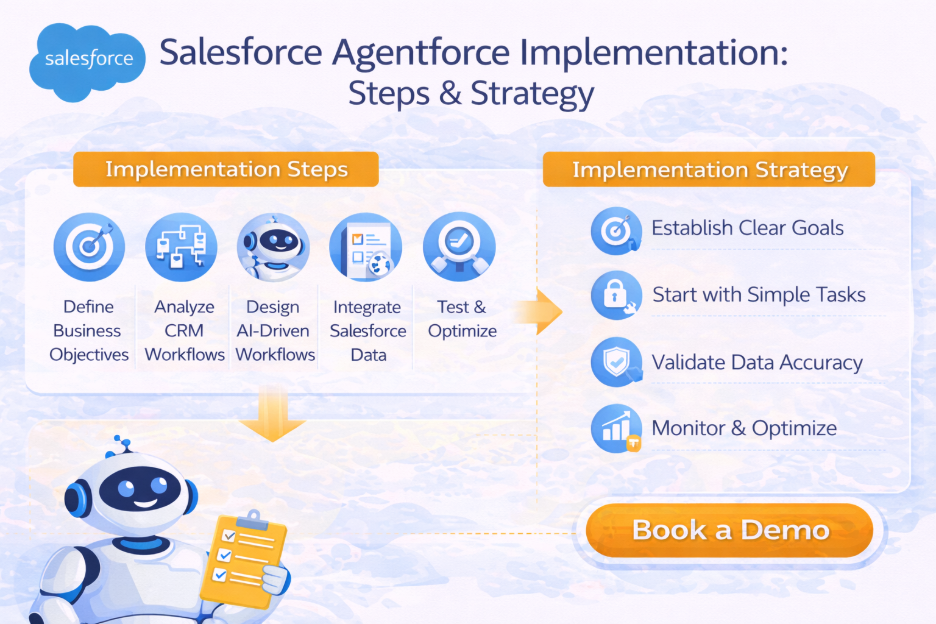
Key Steps in Salesforce Agentforce Implementation
A structured implementation process ensures businesses gain the most from Agentforce.
Step 1: Define Business Objectives
The first step is to identify the problems you want to solve.
Companies might aim to automate customer service requests, streamline workflows, or reduce manual CRM tasks. Setting clear goals aligns the implementation strategy with desired business results.
Step 2: Analyze Existing CRM Workflows
Before adding automation, it’s crucial to assess current processes within Salesforce.
Understanding how service requests, approvals, and workflows work helps organizations spot opportunities for automation.
Step 3: Design AI-Driven Workflows
Once workflows are mapped, the next step is to create automation logic.
Agentforce agents can be set up to:
– Respond to common customer questions
– Automatically route support tickets
– Trigger service workflows
– Update CRM records in real time
This stage ensures automation fits well with actual business operations.
Step 4: Integrate with Salesforce Data
Agentforce performs best when linked to Salesforce data sources, such as:
– Customer records
– Service cases
– Knowledge bases
– Transaction history
This connection allows AI agents to give accurate and context-aware responses.
Step 5: Test and Optimize
Testing checks that automated workflows work correctly before full deployment.
Organizations should monitor:
– Response accuracy
– Workflow execution
– Customer interaction results
Ongoing optimization makes sure the system gets better with time.
Best Practices for Agentforce Implementation
Successful deployments follow several best practices.
First, start with high-volume repetitive tasks. Automating basic questions like password resets or order tracking shows value quickly.
Second, keep human oversight. AI agents should handle routine tasks while more complex issues go to human support teams.
Third, ensure clean and structured data in Salesforce. AI agents depend on accurate data to make decisions.
Finally, track performance regularly to refine automation logic and improve service quality.
Common Implementation Challenges
Organizations implementing Agentforce may face challenges like poor data quality, unclear automation workflows, or insufficient employee training.
Proper planning, expert consulting, and phased implementation can minimize these challenges.
Conclusion
Salesforce Agentforce can change customer service and CRM automation, but successful implementation needs careful planning and technical know-how.
Organizations aiming to deploy Agentforce effectively often work with experts who understand both Salesforce’s structure and AI automation strategies.
Cloud Analogy provides thorough Salesforce consulting services and specialized Salesforce Agentforce consulting services to help businesses execute their Agentforce implementation successfully.
As a skilled Agentforce implementation partner, our team supports CRM transformation, Salesforce AppExchange app development services, and enterprise automation initiatives.
When choosing top Salesforce consulting firms or evaluating trusted Salesforce implementation companies, organizations look for reliable partners who can deliver measurable business results.
Follow Cloud Analogy on social media for the latest Salesforce insights and book a demo today to explore our Agentforce solutions.