Sharing is caring!
The Salesforce ecosystem never stands still. Just when businesses think they have mastered the platform, Salesforce raises the bar once again. As the saying goes, “the only constant in technology is change,” and Salesforce Headless 360 is a perfect example of this evolution.
With the rise of AI agents, autonomous workflows, and API-first architectures, traditional CRM interactions are rapidly changing. Businesses no longer want employees switching between multiple screens and applications to complete routine tasks. Instead, they want intelligent systems that can access data, trigger workflows, and execute business processes automatically.
This is where Salesforce Headless 360 comes in.
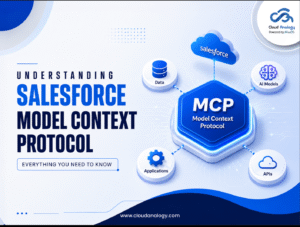
Announced as one of the most transformative platform innovations in Salesforce’s history, Headless 360 enables organizations to access Salesforce data, business logic, automation, and AI capabilities without relying on traditional user interfaces. Through APIs, Model Context Protocol (MCP) tools, and CLI commands, businesses can empower AI agents, developers, and applications to interact directly with Salesforce.
For organizations seeking advanced Salesforce consulting services, implementing Headless 360 represents a significant opportunity to accelerate innovation, improve operational efficiency, and prepare for an AI-first future.
Table of Contents
- Understanding Salesforce Headless 360
- How Salesforce Headless 360 Works
- Key Features and Components of Headless 360
- Benefits and Business Impact of Headless 360
- Implementation Best Practices and Considerations
- Why Headless 360 is the Future of Enterprise CRM
Understanding Salesforce Headless 360
Salesforce Headless 360 is an API-first architecture that separates the user interface from Salesforce’s backend services, business logic, workflows, and customer data.
Traditionally, users interact with Salesforce through Lightning pages, dashboards, Experience Cloud portals, and custom applications. In a headless environment, however, the interface becomes optional. Instead, applications, AI agents, chatbots, mobile platforms, Slack workspaces, and external systems can directly access Salesforce capabilities through APIs and intelligent service layers.
Simply put, Salesforce remains the system of record, while businesses gain complete freedom to create customer experiences anywhere.
Why Salesforce Introduced Headless 360
Recent enterprise technology trends reveal why this transformation is happening:
- More than 80% of organizations are increasing AI investments.
- API-first businesses deploy new capabilities significantly faster than traditional organizations.
- Enterprises increasingly require omnichannel experiences across mobile, web, messaging, and voice platforms.
- AI agents are becoming active participants in business processes rather than simple assistants.
Headless 360 enables Salesforce to serve as the foundation for this new generation of AI-powered enterprise operations.
How Salesforce Headless 360 Works
At its core, Salesforce Headless 360 exposes platform capabilities through three major access patterns:
- APIs (Application Programming Interfaces)
Every Salesforce capability becomes accessible through API requests.
Examples include:
- Retrieving customer records
- Creating opportunities
- Updating service cases
- Triggering workflows
- Running reports
- Accessing Data Cloud information
Instead of navigating screens, systems interact directly with Salesforce services.
- MCP Tools (Model Context Protocol)
Model Context Protocol enables AI agents to discover and use Salesforce capabilities as tools.
For example, an AI sales assistant can:
- Retrieve account information
- Launch approval processes
- Execute workflows
- Generate reports
without requiring custom integration development for every task.
- CLI Commands (Command Line Interface)
Salesforce Headless 360 allows developers and AI agents to execute platform actions directly from command-line environments.
This includes:
- Metadata deployments
- Configuration updates
- Testing and validation
- Workflow deployments
- DevOps automation
This approach significantly accelerates development and deployment cycles.
- Simplified Architecture Flow
Customer Channels / AI Agents / Applications
↓
APIs • MCP Tools • CLI Commands
↓
Agentforce • Data Cloud • Flows • Apex • Automation
↓
Salesforce Customer 360 Data Layer
The result is a highly scalable, AI-ready architecture capable of supporting modern enterprise requirements.
Key Features and Components of Headless 360
Salesforce Headless 360 combines multiple platform innovations into a unified architecture.
Data 360: Data 360 serves as the trusted data foundation of the platform.
It exposes:
- Customer profiles
- Service histories
- Transaction records
- Sales data
- Marketing interactions
through APIs and agent-accessible services.
Agentforce: Agentforce is Salesforce’s AI execution layer that enables businesses to build, deploy, and manage intelligent agents.
Organizations leveraging Salesforce Agentforce consulting services can rapidly develop AI-powered assistants capable of handling customer service, sales operations, compliance tasks, and workflow automation.
Agentforce Vibes 2.0: Agentforce Vibes 2.0 provides an AI-native development environment supporting advanced language models.
Capabilities include:
- Code generation
- Metadata understanding
- Automated deployment
- AI-assisted testing
- Context-aware development
Agent Experience Layer: One of the most innovative components of Headless 360 is the Agent Experience Layer.
Organizations can build interactions once and deploy them across:
- Slack
- Microsoft Teams
- Mobile applications
- Web applications
- Customer portals
Agent Fabric: Agent Fabric provides centralized governance over:
- AI agents
- Language models
- Workflows
- APIs
- Security controls
DevOps Center MCP: The DevOps Center MCP streamlines software delivery by integrating Salesforce directly into CI/CD pipelines. Developers and AI agents can collaborate seamlessly throughout the development lifecycle.

Benefits and Business Impact of Headless 360
The advantages of Salesforce Headless 360 extend far beyond technical modernization.
- Accelerated Innovation: By separating frontend experiences from backend services, organizations can update customer experiences without impacting core business processes.
- AI-Driven Business Operations: Headless 360 allows AI agents to create records, update customer information, trigger workflows, execute approvals, resolve service requests without requiring manual intervention.
- Omnichannel Experiences: Organizations can deliver consistent experiences across multiple channels while maintaining a single source of truth within Salesforce.
- Reduced Integration Complexity: Instead of creating separate integrations for each platform, businesses can expose standardized services through APIs and MCP tools. This reduces development costs and simplifies architecture.
- Preservation of Existing Investments: Organizations can continue leveraging Validation rules, Approval processes, Automation workflows, Security models, & Sharing rules while modernizing customer experiences.
- Enhanced Developer Productivity: Developers can use preferred tools while still accessing Salesforce functionality, reducing platform dependency and improving efficiency.
Implementation Best Practices and Considerations
While the opportunities are significant, successful Headless 360 adoption requires strategic planning.
Centralize Business Logic – Business rules should reside within:
- Flows
- Apex
- Validation rules
- Platform Events
rather than user interfaces.
Prioritize Security and Governance – Organizations should implement:
- OAuth authentication
- Connected Apps
- Role-based access controls
- API governance frameworks
- Agent monitoring
Design for Idempotency – AI agents may repeat actions during execution. Systems should ensure that repeated requests produce consistent results without unintended side effects.
Optimize API Usage – Because headless architectures increase API consumption, organizations should:
- Minimize redundant calls
- Use bulk operations
- Implement caching strategies
- Monitor API utilization
Maintain High-Quality Metadata – AI agents rely heavily on metadata to understand business context. Clear field descriptions, labels, and documentation improve agent accuracy and decision-making.
Adopt Comprehensive Testing Strategies – Testing should cover Agent interactions, API performance, Workflow automation, Security controls, & Edge-case scenarios.
Why Headless 360 is the Future of Enterprise CRM
Organizations are moving toward environments where AI agents, applications, and systems perform operational tasks autonomously while humans focus on strategic decision-making.
Salesforce Headless 360 supports this vision by enabling:
Agents Over Browsers: AI agents gain direct access to enterprise data and workflows without requiring traditional interfaces.
Build Once, Deploy Everywhere: Organizations can create experiences once and deploy them across virtually any digital channel.
Faster Innovation Cycles: Frontend and backend teams can work independently, accelerating development and deployment.
Strong Governance and Compliance: Existing Salesforce security, permissions, and governance frameworks remain intact.
AI-Ready Enterprise Infrastructure: Headless 360 transforms Salesforce from a traditional CRM into a fully programmable enterprise platform capable of supporting future AI initiatives.
As enterprises continue investing in autonomous operations, intelligent workflows, and customer-centric experiences, Salesforce Headless 360 is positioned to become a foundational technology for next-generation digital transformation.
Conclusion
Salesforce Headless 360 represents one of the most significant architectural shifts in the platform’s history. By removing UI dependency and exposing business capabilities through APIs, MCP tools, and AI-ready services, Salesforce is enabling organizations to embrace a truly agent-first future.
From omnichannel customer engagement and autonomous business operations to faster innovation and reduced integration complexity, Headless 360 unlocks new possibilities for enterprises across every industry.
Whether you are exploring AI adoption, modernizing your CRM ecosystem, or building intelligent customer experiences, partnering with a trusted provider of Salesforce consulting services, Salesforce Agentforce consulting services, and an experienced Salesforce consulting partner can help you maximize the value of this revolutionary platform innovation.
Ready to Future-Proof Your Salesforce Ecosystem? Our certified Salesforce experts help businesses design, implement, and optimize Headless 360 architectures, Agentforce solutions, and AI-driven customer experiences. Contact the best Salesforce summit consulting partner today to discover how Salesforce Headless 360 can transform the way your organization works, innovates, and scales.

Ajay Dubedi
CEO | Founder
Ajay Dubedi, the founder and CEO of Cloud Analogy, is a prominent Salesforce Sales, Service, and Marketing cloud Consultant with a rich expertise in handling challenging business models. Ajay has assisted and implemented solutions in industries comprising Banking, Health Care, Networking, Education, Telecommunication and Manufacturing. Ajay is globally acclaimed for his extensive experience in APEX Programming, VisualForce pages, Triggers, Workflows, Page Layouts, Roles, Profiles, Reports & Dashboards.Hire the best Salesforce Implementation Partner. Choose Cloud Analogy, the world's most preferred Salesforce Implementation Company that provides custom CRM Implementation services.